After describing the conflicting forces and binding forces, we can discuss the stability of the society. Different societies have been stable for a long time though many of them are now extinct. To explain the change in society we will use an analysis which is primitive but sufficient for our purpose at present.
First of all, we consider a simple model of two individuals A and B. Each of them is having a given amount of resources and linkages. Their benefits are derived from these resources mainly: the land, the capital, the knowledge, the labor and the linkages. We are including the bonding and the in linkages. We assume that benefits and costs can be measured in some unit say U. The costs are provided by scarce raw materials and the conflicting forces in the society. This enables us to club the benefits of different resource and aids in simplifying the model. The efforts of A and B are in such a way to maximize their net gains or benefits. We further assume that total benefits increase at a decreasing rate and total cost increase at an increasing rate. These are simplifying assumptions used in Economics. Therefore the marginal benefit curve or function when plotted against the efforts shows a decreasing tendency and the marginal cost curve or function shows an increasing tendency when plotted against the efforts. These effort curves contain the efforts of utilizing the resources at the command of an individual.
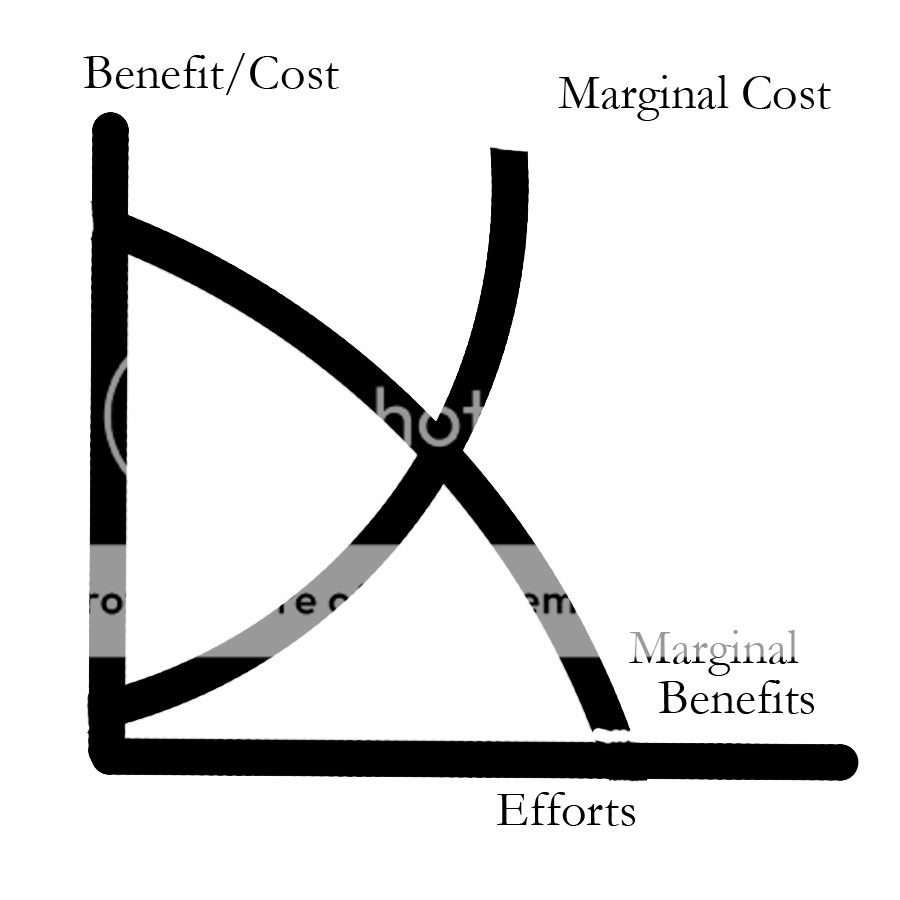
There may be many factors responsible for such behavior of these curves but the main factor is the paucity of resources and the fact that any amount of raw material can produce only a certain amount of output and not more than that. We can say that
Input + efforts (value added) = output.
Thus, the inexhaustible gains are not possible with any given technology in society. The additional gains are limited in our model and hence we have the following shape of marginal cost and marginal benefit curves. The marginal benefits are additional benefits which occur when one additional unit of efforts is used. The marginal cost is the additional cost which is incurred when one additional unit of efforts is used.
The equilibrium is attained, when everything else remains constant, at a point where marginal benefits and marginal costs are equal to each other. This implies that further net gains are not possible by changing the efforts.
Now at this effort level the individual has certain net benefits or resources at his command which are constant because of our assumption that everything else remains constant. Let these resources be denoted by total land (L), total capital (K), total education and knowledge (E), total labor (LB) and total linkages (LNK) and total cost by (C). The net resources at the command of an individual A may be denoted by La + Ka + Ea + LBa + LNKa – Ca. Similarly for individual B the net resources we have Lb + Kb + Eb + LBb + LNKb – Cb. The capital resource denote resources and small letters denote individuals. So Kb is the Capital of individual B.
The change in society comes from changes in the technology, ideology, religion, culture, economics and law etc. The conquests also change the society. We define the total status as status space where Status (S) equal addition of status spaces of all the entities in our model S= Sa + Sb. A and B are living in a society where total status space is denoted by S and individual status as Sa and Sb. The status we have defined here is the ability to move the resources in the society under consideration. Now we define pressure as total pressure P which can be exerted by an individual in the society is equal to resources at his command. It is simplifying assumption. The average pressure p is denoted by division of his resources by status space at his command. We assume that the total pressure (Pa) exerted by an individual A is equal to benefits/resources at his command.
The total pressure is denoted by capital P
Pa = (La + Ka + Ea + LBa + LNKa – Ca)
The average pressure denoted by small p (pa) exerted by individual A will be
pa = (La + Ka + Ea + LBa + LNKa – Ca) / Sa
where Sa is status space of individual A.
And the average pressure exerted by B will be
pb = (Lb + Kb + Eb + LBb + LNKb – Cb) / Sb
Considering a uniform status space the condition for equilibrium is pa = pb. Thus, we have
(La + Ka + Ea + LBa + LNKa – Ca) / Sa =
(Lb + Kb + Eb + LBb + LNKb – Cb) / Sb
Now let us consider the result of our simplified model. The conditions of equilibrium imply a stable society but not necessarily an egalitarian society. In fact, it may reflect extreme equalities. Let us consider a case where A is very poor and B is very rich then resources at the command will be very low as well as his status and resource at B’s command will be very high as well as his status. Individual B is able to exert very high pressure on A and occupies a major portion of status space forcing A to be content with small status space. As A’s space is reduced his average pressure is increased to the point where his average pressure increases to equal the B’s pressure. The activities may oscillate around the equilibrium conditions.
It may also be seen that any increase in linkages (LNK) and knowledge (denoted by E) will increase the status space of an individual.
By introducing n number of individuals and maintaining uniform status space we find that for equilibrium conditions we have
R1/S1 = R2/S2=…=Rn/Sn
Where
Rn = Ln + Cn + En + LBn + LNKn – Costn
Thus, in equilibrium conditions the average pressure exerted by each individual is equal in a uniform social space. Each individual remains in the position according to resources at his command which decide the average pressure exerted by him. The society in question is stable and no significant movement takes place.
The untouchables and the Shudras have the minimum resources at their command which reduces their relative status giving them a suffocated room to play. In the absence of capital, education, land and linkages their maneuvering powers are very low forcing them to live at the margins of the society with little status space or the lowest and meager status space. They have to live in their body labor alone which is their sole possession courtesy the Varna Dharma.
Let us consider the grouping in the society. The grouping is provided by linking and delinking by individuals in the society. First delinking which may be considered is by blood relations (blood relation = br). Let it be denoted by LNKbr(A1, A2, A3, …, An) for individuals A1, A2, A3 and so on. If they do not marry into each other then LNKbr(A1, A2, A3, …, An) = 0 and they form different groups. Considering three A, B and C if LNKbr(A, B) =0 and LNKbr(A, C) = 0 but LNKbr (A1, A2, A3,…) = 1 then the people belonging to A form an exclusive group. The example of this group may be the royals of the medieval times.
The groups may also be formed according to main resource at the command of individuals. These groups may include capitalists, workers, rulers, knowledge workers etc. these groups may also be income based. The groups developed on the basis of religion or ideology are also extremely important.
For landlords, capitalists and workers we have where these groups are mutually exclusive –
K/S capitalist = L / S landlord = Labor / S worker
From the above we can see that if the workers want to improve their status then the normal way out is to increase their skills if they are allowed by the other groups.
In the case of well defined groups the equilibrium will be attained when the average pressure exerted by each group is equal to average pressure of each group. The group having large resources at its command will push others down the status space. This group need not be very large. This group may actually be in minority but commands a large portion of resources. In this situation, the society will be stable and this equilibrium may last for a long time until something new happens. The different strata are in equilibrium with each other though extreme inequalities may persist. Every group has made peace with each other.
The changes in the society may come from external sources or forces or development of new forces in the society which redistributes the command of resources.
Let us first take the case of conquests first because it seems to be simplest. The conquest increases the conflicting forces and shift up the cost curve of local people. The status space of local rulers or people is reduced. One stratum is added above the previous highest stratum. The defeated people become the subordinated people. The violence continues until the equilibrium is reached; the violence ceases and an apparent harmony or peace comes into existence.
Then let us take the discovery of agriculture. A change in technology enabled strong men to dominate others and live off the surplus produced by them. Now others could produce for them and there was no need to go for hunting and gathering like everybody. This divided the society in two parts. The resources with one group increased which increased their status. The cultivators remained with low status because of absence of any linkage among them while the rulers effectively linked themselves to soldiers and with each other. By using the force, the rulers increased the cost for the cultivators, which reduced latter’s total pressure, and average pressure, which resulted in lowering of their status until new equilibrium, was attained.
In French revolution, the technology increased the resources at the command of middle class which developed linkages with peasants and serfs through the slogan of equality and fraternity. Here the technology which created surplus outside the ruling class and new ideology which developed new linkages outside the ruling class reducing their actual status and turned the status space in favor of the middle class who made the common cause with still lower class then they outranked the ruling class which resulted in violent demolition of the old order.
In Russia and China, the conflict turned very sharply toward violence due to influence of ideology of Karl Marx. The ruling classes were not able to adjust to this. The common interests of lower classes produced fraternity or binding forces among the lower classes which the rulers were not able to face. The change was so abrupt that the violence, which ensued, resulted in killing of millions of people.
To remove the difficulty in adding certain things in our model we can also assume the total pressure to be the addition of the pressure exerted by resources at an individual/groups command and then the average pressure is the total pressure divided by the status space at his command. And equilibrium is attained likewise. And all other things apply.
After the status space has been determined for everybody in the society and the equilibrium has been reached in the society one can find the group or individual behaviors which are in consonance with their status barring some minor deviations.
The total pressure in this case
Pa = f(La )+ f(Ka )+f( Ea )+ f(LBa )+ f(LNKa )– f(Ca)
The average pressure (pa) exerted by individual A will be
pa = f(La )+ f(Ka )+f( Ea )+ f(LBa )+ f(LNKa )– f(Ca) /Sa
Where sa is his status space.
And the average pressure exerted by B will be
pb = f(Lb )+ f(Kb )+f( Eb )+ f(LBb )+ f(LNKb )– f(Cb) / Sb
Considering a uniform status space the condition for equilibrium is pa = pb. Thus we have
(f(La )+ f(Ka )+f( Ea )+ f(LBa )+ f(LNKa )– f(Ca) )/ Sa =
(f(Lb )+ f(Kb )+f( Eb )+ f(LBb )+ f(LNKb )– f(Cb)) / Sb
For landlords, capitalists and workers we have where these groups are mutually exclusive –
f(K)/S capitalist = f(L)/ S landlord = f(Labor )/ S worker
The Caste Behavior
Now we will analyze the behavior of new land owning Shudras in the status framework described in the previous chapters.
A landed Shudra is inferior in status to twiceborn but he is superior to the landless Shudras and without saying to the Untouchables also. Some of these Shudras castes are known as forward castes - this term was coined to identify them separately telling that they could not be classified as Kshatriyas or Vaisyas. We can classify them as the Pseudo-Kshatriyas below the real Kshatriyas and the real Vaisyas. The status of a man is always relative. A landed Shudra (Pseudo-Kshatriya) faces the twin objective of maximizing his superiority over untouchables and minimizing his inferiority in relation to higher castes. If he has to reduce the distance between himself and the twiceborn then the easy way out is to become like them; or change him so much as to become similar to them in cultural and behavioral ways and values. The idea is to gain their acceptance/approval or to be identified with them. If the high castes recognize him as one of their own then his purpose is served. He then belongs to the higher stratum. But that is simply impossible; a Shudra at the most can go near to them but cannot become their equal; he does not have the necessary purity of origin. The impurity is the evergreen feature of a Shudra of any status. However, he can become their near equal which is the position slightly below them. No Shudra in fact can aspire for more than that. The divinity did not create him for that. That is why we call the forward Shudra castes as pseudo-Kshatriyas or Pseudo-Vaisyas. If he has to reduce the distance between him and the higher castes then he would have to follow their behavior and try to intermix with them. If he were in a position to do so then his status would increase. The Manusmriti also says that a Shudra can become a virtuous Shudra by mimicking the higher Varnas; all the Shudras being impure, should follow the dharma Shastras. However, if a landed Shudra is able to mimic the twiceborn successfully then he is likely to raise his status to their level at least in social transactions if not in other spheres. They would not hesitate in talking and dining with him. In short, he has to become a cultured man of their sort or accultured. At the same time, he would have to keep on increasing the distance between him and the untouchables so that his relative superiority is increased. This would also help him to gain the much needed acceptance among the higher castes; of course the aim of the life is to rise up. He may even go to the extent of committing atrocities on them. His average pressure against the untouchable has increased. This justifies their feelings of having a higher social hierarchy. He has to carry all the baggage that comes with the identification with the higher castes.
In India, the process of minimizing the inferiority in status is known as the Sanskritization. The free redistribution of land enabled the tiller Shudras to become independent. It also left them with sufficient resources to show their superiority in the rural areas but it did not get them a higher status among the twiceborn. To be accepted by the higher Varnas and to have a feeling of social dominance, they started committing atrocities on the untouchables, copying a time-tested tradition of assertion of superiority by the higher castes. They started copying clothes, eating habits and social behavior of Brahmans and others. The patronization of Brahmans now starts. They started inviting the Brahmans, now and then, for performing the ritual ceremonies which they can pay for now. If Brahmans are willing to do that then their social status is raised for sure. There is no reason that they would not do it. It is ancient history repeating itself. If you want to become a Hindu - start patronizing the Brahmans. No actual ceremony is needed; you should arrange for your own marriage in your own endogamous group; then you can bribe a Brahmin priest to perform the marriage and touch his feet.
A Shudra knows it very well that a Brahman cannot be beaten within the Hindu framework. The traditions prohibit it. The society does not like it. Nobody wants the structure to be broken with which he was born and with which he grew up, even when the system is the most unjust and the cruel one. His forefathers touched their feet! How can one talk back to Brahmans then? Anybody respectful to his ancestors and their religious way of life ways is bound to show respect to the sacred lawmakers. Here, everything is decided by them. The Shudras in their interest follow the betterment of their social ranking. The idea of trying to overtake the Brahmans never crosses their minds. The superiority of the pious and dharmic lawmakers is a fait accompli. However, the maximization of superiority causes the landed Shudras to commit atrocities on the Untouchables. That is to distance themselves away from the fifth stratum and behave like upper castes; it serves twin purposes.
However, it is difficult to single out the landed Shudras for practicing casteism. The first credit goes to the Brahmans who being the most pure and highest Varna moved up to the status of sacred and demigods. In the times of Peshawa rule, they came to be known as Brahmandev (Brahman god) and Bhu-dev (god on land). This was the result of maximizing their superiority. On the other hand, the maximization of superiority also led to degradation of agriculture and cattle rearing to lower level, from Vaisya to Shudra level. This process also led to degradation some Shudras to untouchable level.
We will examine the extent of prevailing of casteism in Hindu society. Is it limited to only upper strata or the others are also its practitioners? The upper strata consist of three higher Varnas also called twiceborn for they are eligible for the thread ceremony. The lower two strata are not eligible for the thread ceremony indicating their lower status as compared to the twiceborn. The fourth stratum of Shudras is superior to the untouchables. The untouchables are condemned to live a wretched life. Nobody bothers because it suits everybody’s ends.
The idea about the elimination of caste is the same for all the castes and individuals. This common idea can be described as follows. But before that let us see what the caste structure is. The caste system in India is a hierarchal system of different castes which are endogamous in nature. Each caste has a given heredity occupation and heredity-based purity and social standing. The purity decreases down the caste scale and increases up the caste scale. The privileges decrease down the caste scale and disappear altogether for the lowest stratum.
The common idea of abolishing the caste of each caste is that each caste wants to be equal to castes higher than it but maintain its superiority in comparison to still lower castes. It is maximization of superiority and minimization of inferiority. Like a Jatt wants to be equal to the twice-born but at the same time maintain his superiority over the lower castes to him. And the same likewise is true for Yadavs or Reddys or even the Chamars. Ironically the Chamars are untouchable themselves. So everybody wants to solve the caste system for himself only. Everybody wants a change where he is not badly affected but gains out of it. Everybody demands equality for himself but denies it to those below him. A contradiction follows and the absence of mutual interest keeps the system going on.
This same common idea full of self-interest prevents the people of castes on higher scale to unite with the people with castes on lower scale. This common idea has no common point of agreement. Everybody refuses to join forces with the lower castes than him. Since everybody is doing it, no unity against the caste system is achieved. And in the absence of such viable opposition the caste system thrives on.
Such a common idea actually means downward discrimination by all the castes including the Chamars. The Chamars discriminate against the Bhangis but wants equality and respect from castes higher to them. There is inherent inner contradiction in such an utterly selfish solution to abolish the caste. The lowest caste in the system (Bhangi) cannot discriminate because it does not get a chance. Therefore, it is futile to say that only upper caste practice caste discrimination while others are free from it. The casteism is ubiquitous in Hindu society.
Thus, it can be said that all people in Hindu society are casteists whether they belong to the high castes or the low castes. In such a situation and thinking, there is little hope for equality in the society.
Overall, everybody is trying to raise his status to the extent possible and use both maximization of superiority and minimization of inferiority during the process. This results in practice of casteism even among the untouchables. There are many jatis in untouchables and these are ranked vertically on basis of relative purity of their respective inherited occupations and the separation of bloodlines or endogamy. There is not much difference in economic status; all of them are poor. And they practice casteism against each other! The purity paradigm – the more impure against the most impure – both of them are poor. Thus, everybody in Hindu society from the top of the heap to the bottom of the heap practices casteism. And all of them needlessly keep on accusing others of practicing casteism.
However, the benefits of the casteism were/are reaped by the higher castes because they control/controlled the resources and can exploit the situation to benefit them. The effectively put lower castes against each other and enjoy an easy life. The lower castes though practice casteism never benefitted by it; they could not move any resources in the society or economy; instead, they got moved. The exploitation was the sole prerogative of the high castes.


No comments:
Post a Comment