There is injustice spread all over the place and still nothing much is done about it. Often people are found making peace with the unjust system which perpetrates injustice. Some people do it out of assumption that the unjust system is right because it belongs to them. They are part of it just like an organ is part of a body which cannot have its existence outside the body. However, sometimes it is a well thought out reaction. Because disagreeing with the society means breaking away from the beneficial binding forces of the system. The eventual breakage of linkages reduces his/her status in the society. This is avoided by them by agreeing to society. After all, a man is social animal and an unjust society takes full advantage of that. There are times the oppressed people are found justifying the system which oppresses them or puts at them at disadvantage. They may not be willing but they have to make peace with the oppressing system to avoid further oppression.
Let us go back to our simple model where the claims and counter claims must be equal for justice. Let us say somebody A has gone out and physically assaulted B. this creates an imbalance in justice until B’s counter claim is also realized to bring the justice. As long as B’s claim remains outstanding the injustice will prevail in the system. The outstanding claim of B can be taken to be equivalent to injustice prevailing due to assault of A on B. The superiority of A increases relative to B who is now inferior to A in the same measure. The resultant superiority and inferiority are equal and opposite and equal to each other.
Now B wants justice for the wrong done to him by A. Every system has its own version of judicial system and sense of right and wrong. However, we go along with our concept of justice and leave the judicial system as it is. Now here we will make two simplifying assumptions in our simple model. One is that the cost of availing justice increases in an increasing way with the increase in the justice sought. This mean that marginal cost of availing justice increases with the justice sought. The second assumption is that the benefit of justice rises less and less with more and more justice. This means that the marginal benefits of availing justice fall. Let us consider a situation where A has stolen money of B. B only wants the money back and nothing else. The judicial system not only gives B back the money but also awards corporal punishment to A. This may not be liked by B since he has already been compensated for his loss. Here B feels some feelings of uneasiness – here we can say that the additional benefits of justice are negative. The additional benefits have become negative from positive.
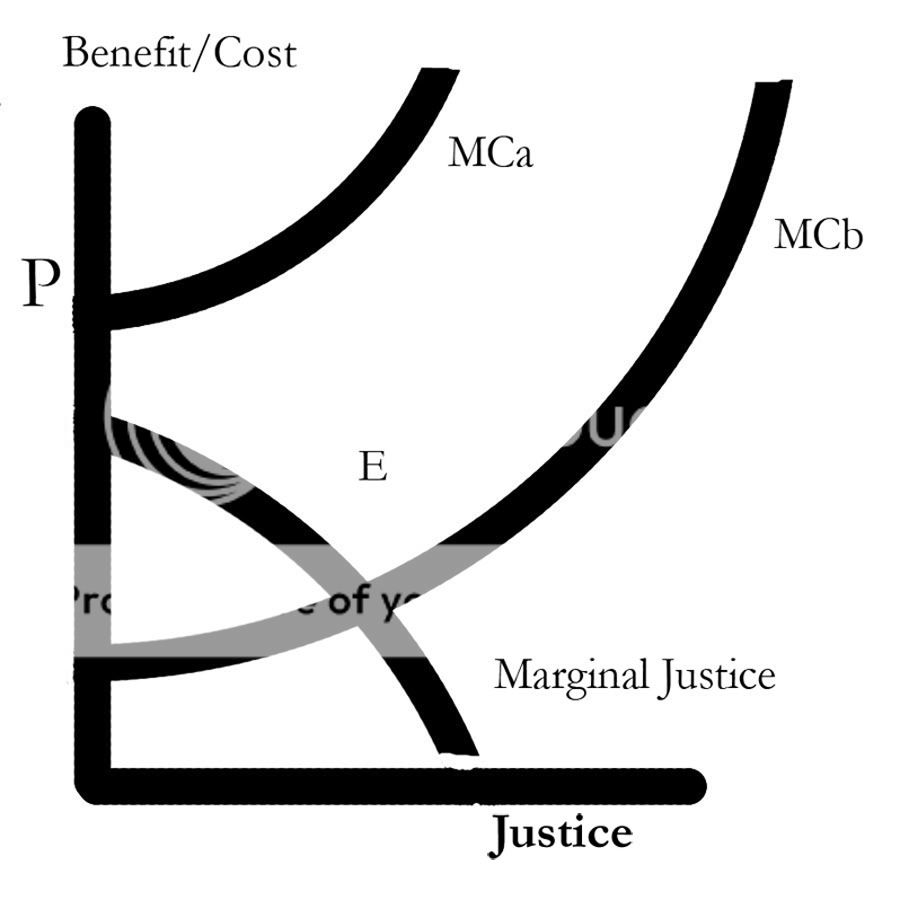
The curve showing marginal cost will rise up steadily and curve showing marginal benefits will fall down with more and more justice. The justice equilibrium will be where the marginal benefit equals marginal cost. This will be shown by intersection of these two curves. Well if everything goes all right the B will get the required justice. But there are many ifs and buts in between. Certainly A will not take this justice peacefully because he stands to lose. Suppose A has the power to shift up the marginal cost of B up then the justice what B gets will be smaller than what would be any absence of course of action chosen by A. A may have the power to push and push up the curve so that all marginal benefits lie below the marginal cost of B. In this situation, B will give up the quest for justice. Powerful A can do it by giving threat of further violence, by giving threat to life of B, by giving threat to hurt the near and dear ones of B. One more option A may choose is to bribe his way out. Thus in a rational manner (which saves his interests) A may successfully obstruct the justice. And leave B high and dry. B may have no option but to resign unwillingly and make peace. In certain conditions B may not be eligible to get the justice and hence the injustice would prevail in the society and A would always have free and upper hand. In other words, the poor, the deprived, the ineligibles and part ineligibles, people with minimum social linkages and excluded people are less likely to get some kind justice or any kind of justice.
The rich and powerful, people with strong social linkages are more likely to get away after creating injustice as compared to resourceless people. The system in place may just ignore the people at the bottom of society. The point P in the following graph is the point above which the people make peace with the unjust system. It is kind of forced peace with injustice.
Let us go back to our simple model where the claims and counter claims must be equal for justice. Let us say somebody A has gone out and physically assaulted B. this creates an imbalance in justice until B’s counter claim is also realized to bring the justice. As long as B’s claim remains outstanding the injustice will prevail in the system. The outstanding claim of B can be taken to be equivalent to injustice prevailing due to assault of A on B. The superiority of A increases relative to B who is now inferior to A in the same measure. The resultant superiority and inferiority are equal and opposite and equal to each other.
Now B wants justice for the wrong done to him by A. Every system has its own version of judicial system and sense of right and wrong. However, we go along with our concept of justice and leave the judicial system as it is. Now here we will make two simplifying assumptions in our simple model. One is that the cost of availing justice increases in an increasing way with the increase in the justice sought. This mean that marginal cost of availing justice increases with the justice sought. The second assumption is that the benefit of justice rises less and less with more and more justice. This means that the marginal benefits of availing justice fall. Let us consider a situation where A has stolen money of B. B only wants the money back and nothing else. The judicial system not only gives B back the money but also awards corporal punishment to A. This may not be liked by B since he has already been compensated for his loss. Here B feels some feelings of uneasiness – here we can say that the additional benefits of justice are negative. The additional benefits have become negative from positive.
The curve showing marginal cost will rise up steadily and curve showing marginal benefits will fall down with more and more justice. The justice equilibrium will be where the marginal benefit equals marginal cost. This will be shown by intersection of these two curves. Well if everything goes all right the B will get the required justice. But there are many ifs and buts in between. Certainly A will not take this justice peacefully because he stands to lose. Suppose A has the power to shift up the marginal cost of B up then the justice what B gets will be smaller than what would be any absence of course of action chosen by A. A may have the power to push and push up the curve so that all marginal benefits lie below the marginal cost of B. In this situation, B will give up the quest for justice. Powerful A can do it by giving threat of further violence, by giving threat to life of B, by giving threat to hurt the near and dear ones of B. One more option A may choose is to bribe his way out. Thus in a rational manner (which saves his interests) A may successfully obstruct the justice. And leave B high and dry. B may have no option but to resign unwillingly and make peace. In certain conditions B may not be eligible to get the justice and hence the injustice would prevail in the society and A would always have free and upper hand. In other words, the poor, the deprived, the ineligibles and part ineligibles, people with minimum social linkages and excluded people are less likely to get some kind justice or any kind of justice.
The rich and powerful, people with strong social linkages are more likely to get away after creating injustice as compared to resourceless people. The system in place may just ignore the people at the bottom of society. The point P in the following graph is the point above which the people make peace with the unjust system. It is kind of forced peace with injustice.
In addition to making peace with system, there may be situations where the justice is over achieved where the high-level punishments are given for minor offences. Here, either the judicial system or the lawmakers may be at fault. The punishment should equal to unjust act carried out. The long term or capital punishments should not be given for minor offences. In that, the justice is not achieved and the system owes the accused some compensation which are equal to excess of punishments over the unjustified act carried out or the injustice prevails in the form of automatically created claim of the accused.


No comments:
Post a Comment